How this reference decides what it can say
The site is a structured support/reference product. It does not claim hands-on testing and does not use product appearance as evidence of specifications, fit, compatibility or performance.
Three checks before using a claim
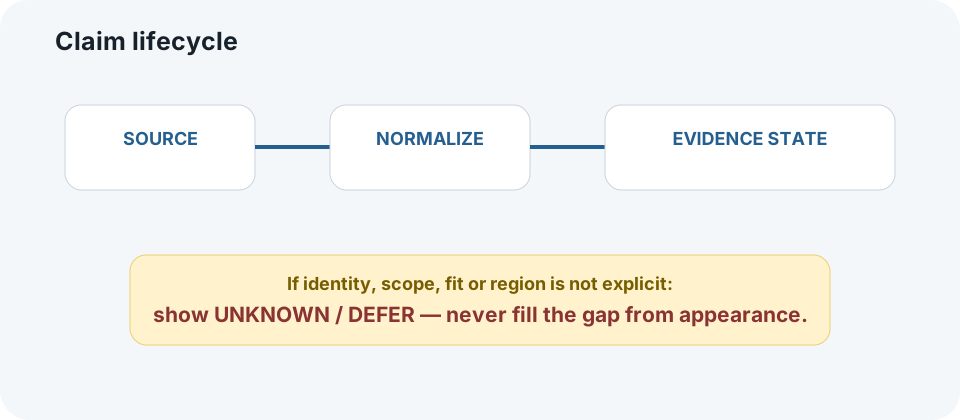
- Exact identity: does the model/SKU and region match?
- Claim scope: is the source supporting identity, specification, lifecycle, or exact compatibility?
- Evidence state: VERIFIED can support the stated field; PARTIAL/CONFLICT/unknown stays bounded.
Accepted evidence hierarchy
- Exact manufacturer product/support page: model identity and fields explicitly stated there.
- Official part record: exact model/part compatibility only when the model is named.
- Accepted project crosswalk: identity, family or regional relationships with relationship type preserved.
- Unknown: any field not established by the accepted record.
What we deliberately do not do
- No copied manufacturer or retailer product photography.
- No fake first-hand testing, ratings, reviews, prices or availability.
- No compatibility from dimensions, visual similarity or shared marketing family.
- No sibling-spec inheritance for sparse records such as NF702.
- No “current stock” claim from a historical/official support page.
Visual policy
Functional visuals include generation/status maps, decision tables, model-label identification graphics, evidence-state flows and accessory relationship diagrams. A generic object illustration carries the disclosure “Reference illustration — not an exact model depiction.” Data charts and diagrams are derived from accepted fields and are not presented as physical product renderings.
Exact licensed or project-owned product photos can be added later as an enhancement after rights review, but they are not the source of compatibility or specification facts.
Reviewed dates & provenance
Every pilot content page displays a reviewed date and a provenance section. The underlying accepted model, accessory and identity baselines were reviewed on 2026-10-06. Source URLs are surfaced so a user can understand where normalized facts originated.
Corrections / uncertainty
If a source conflict or missing field is found, the safe state is to narrow or defer the claim. accepted reference demonstrates this behavior: it does not invent an NF702 capacity simply because the search query frames a “12 cup” comparison.
Sources used on this page
These links identify the accepted source records behind the normalized facts. A source link is not an image-use license.
- Pilot model baselineSupports: internal accepted model index.
- Accessory evidence baselineSupports: accepted source evidence used for this route; see technical provenance for lineage.
Reviewed 2026-10-06. Facts are reproduced as normalized project evidence, not inferred from product appearance.